The transformation of abdominal surgery over the past three decades has been nothing short of revolutionary. Procedures that once required large incisions, week-long hospital stays, and months of recovery are now routinely performed through three or four small punctures - with the patient home the next morning and back at work within days. This transformation is the result of laparoscopic surgery - and its evolution into robotic-assisted surgery represents the next frontier.
At Niraaya Hospital, Kudasan, Gandhinagar, Dr. Neel Patel (MBBS, MS, FALS - Fellowship in Advanced Laparoscopic Surgery including Robotic Surgery & Hernia, FMAS, FIAGES, EFIAGES) is at the forefront of minimally invasive abdominal surgery in North Gujarat. With fellowship-level training in both advanced laparoscopic and robotic surgical techniques, and 7,000+ minimally invasive surgeries performed over 8+ years, Dr. Patel delivers world-class surgical outcomes for patients from Gandhinagar, Ahmedabad, and across Gujarat - without the need to travel to distant metropolitan centres.
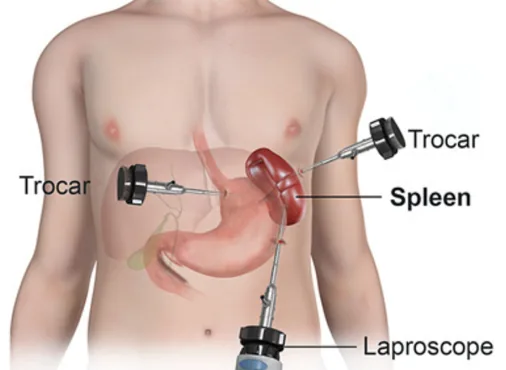
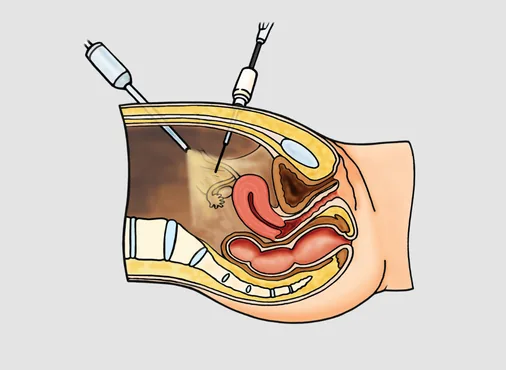
Laparoscopic surgery - also called "keyhole surgery" or "minimally invasive surgery" - is the technique of performing abdominal operations through small (5-12 mm) incisions, using a camera (laparoscope) and fine, long-shafted surgical instruments, guided by a high-definition video display.
The key components:
- Trocar ports: Small plastic tubes (5-12 mm diameter) inserted through the skin incisions to provide access channels for the camera and instruments
- Laparoscope: A rigid telescope with a high-definition camera at its tip, inserted through one of the ports - transmitting a magnified, illuminated image of the operative field to a video monitor
- Carbon dioxide insufflation: CO2 gas is introduced into the abdominal cavity to create a working space (pneumoperitoneum) - lifting the abdominal wall away from the organs and allowing instruments to move freely
- Laparoscopic instruments: Long-shafted graspers, scissors, clip applicators, energy devices (ultrasonic shears, bipolar diathermy), staplers, and suturing devices - manipulated by the surgeon from outside the abdomen through the trocar ports
Robotic-assisted surgery - performed using a robotic surgical system - represents a further evolution of laparoscopic surgery. The robot does not operate independently; rather, it is a sophisticated extension of the surgeon's hands, translating the surgeon's movements at a console into precise, tremor-filtered movements of instruments inside the patient's body.
Key advantages of robotic surgery over standard laparoscopy:
- 3D high-definition visualisation: The robotic system provides a true stereoscopic 3D view (rather than the 2D flatscreen of standard laparoscopy), giving the surgeon enhanced depth perception
- Wristed instruments: Robotic instruments have 7 degrees of freedom (mimicking the human wrist's full range of motion) - unlike standard laparoscopic instruments which have 4 degrees of freedom. This allows suturing, dissection, and reconstruction in narrow, deep spaces that are difficult to access laparoscopically
- Tremor filtration: The system filters out natural hand tremor, improving precision
- Motion scaling: Large movements at the console are scaled down to smaller, more precise movements inside the patient
- Ergonomics: The surgeon operates seated at a console in a comfortable, fatigue-reducing position - particularly advantageous in long, complex procedures
Dr. Neel Patel holds a Fellowship in Advanced Laparoscopic Surgery with specific focus on Robotic Surgery and Hernia (FALS) - making him specifically trained for robotic surgical procedures. He uses robotic assistance for complex hernia repairs, selected colorectal procedures, and other operations where wristed instrumentation and 3D vision provide a meaningful surgical advantage.
.webp)
.webp)
.webp)
.webp)
.webp)