.webp)
01
Piles (Haemorrhoids)
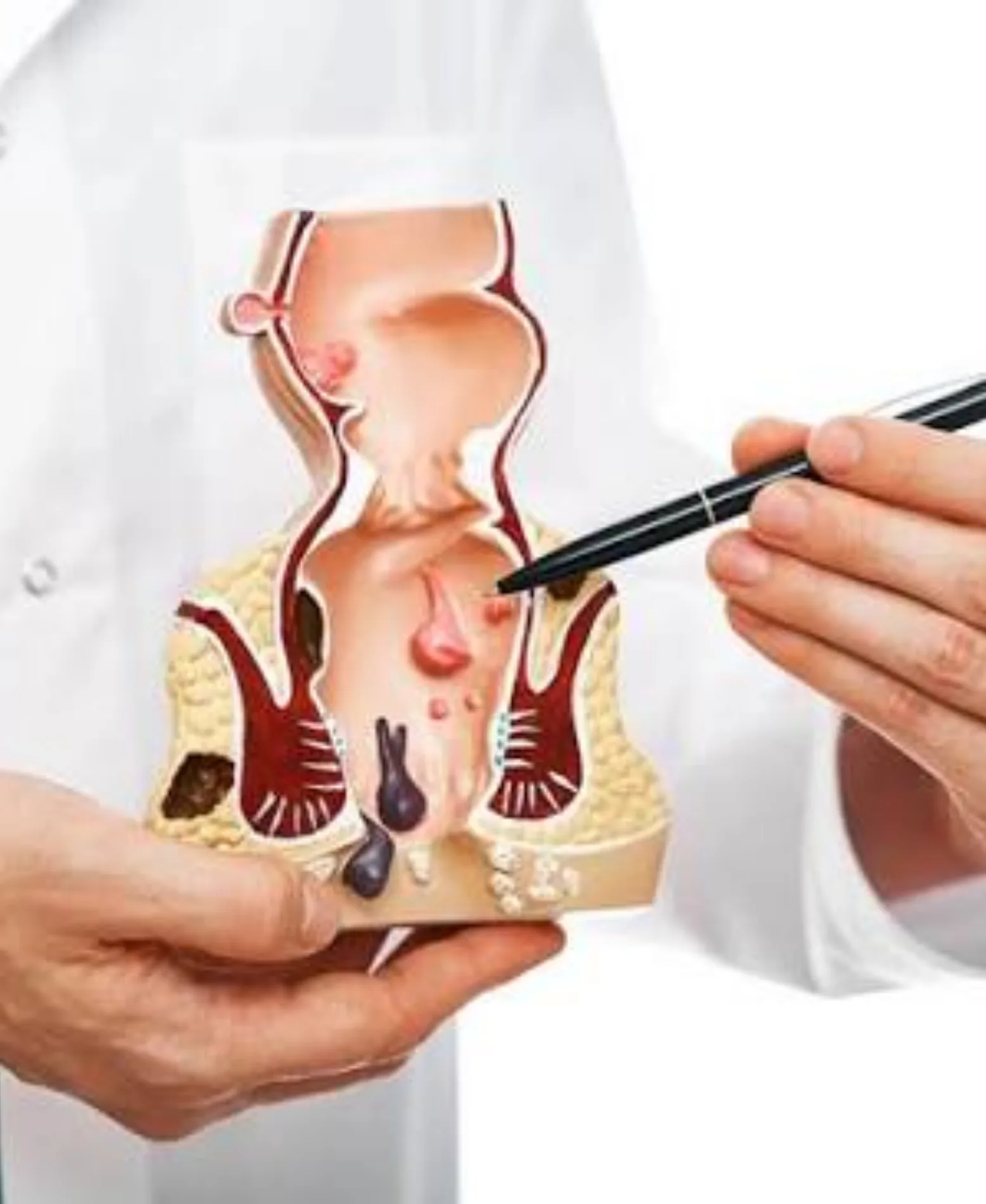
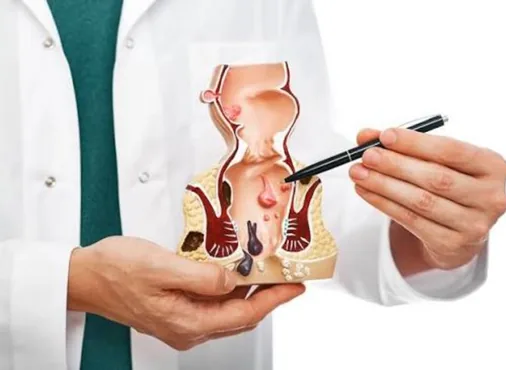
Haemorrhoids are cushions of vascular tissue, smooth muscle, and connective tissue located in the anal canal and lower rectum. They are a normal anatomical structure - present in everyone - and play a role in maintaining continence by supplementing sphincter function. It is only when they become enlarged, prolapsed, or symptomatic that they are referred to as piles (a disease).
Causes and contributing factors: Chronic constipation (straining at stool), low-fibre diet, prolonged sitting (particularly on the toilet), pregnancy and childbirth (increased pelvic pressure), obesity, and a genetic predisposition all contribute to haemorrhoidal enlargement.
Types:
Internal haemorrhoids arise from the internal haemorrhoidal plexus above the dentate line (an anatomical landmark in the anal canal). Because this area has no pain fibres, internal haemorrhoids are typically painless - the hallmark symptom is bright red rectal bleeding (blood on toilet paper, dripping into the bowl, or coating the stool), and prolapse (the haemorrhoid protruding out of the anal canal during defecation).
Internal haemorrhoids are graded by degree of prolapse:
- Grade I: Bleed but do not prolapse
- Grade II: Prolapse on straining but reduce spontaneously
- Grade III: Prolapse on straining and require manual reduction
- Grade IV: Permanently prolapsed and irreducible - or contain thrombosed tissue (acutely painful, bluish-purple swelling requiring urgent treatment)
External haemorrhoids arise from the external haemorrhoidal plexus below the dentate line (where pain fibres are present). They cause pain, swelling, and a feeling of a lump at the anal verge. External haemorrhoidal thrombosis - a blood clot forming within an external haemorrhoid - causes sudden, severe perianal pain with a firm, tender lump, typically occurring after straining, heavy lifting, or constipation.
Treatment Approach
Treatment options at Niraaya Hospital:
Conservative management (Grade I-II): High-fibre diet, adequate hydration, sitz baths, topical medications (steroid/local anaesthetic creams), and avoidance of straining. This resolves acute symptoms in many cases and prevents progression.
Office-based procedures: Rubber band ligation (placing a tight rubber band at the base of the internal haemorrhoid to cut off its blood supply and cause it to slough off) is highly effective for Grade I-II haemorrhoids and selected Grade III.
Laser Haemorrhoidoplasty (LHP): A minimally invasive technique using laser energy delivered precisely into the haemorrhoidal tissue through a fibre-optic probe. The laser energy causes shrinkage and fibrosis of the haemorrhoidal cushion without excision. Advantages: minimal pain (the procedure is performed above the dentate line, in the painless zone), no incision, no sutures, day-care procedure, and very rapid return to activity (next day in most patients).
Stapler Haemorrhoidectomy (MIPH / PPH - Procedure for Prolapse and Haemorrhoids): A circular stapling device removes a ring of prolapsed mucosal tissue above the haemorrhoids, repositioning the haemorrhoidal cushions upward and interrupting their arterial blood supply simultaneously. Highly effective for Grade III and large Grade II internal haemorrhoids. Less painful than conventional haemorrhoidectomy, shorter hospital stay, and faster recovery.
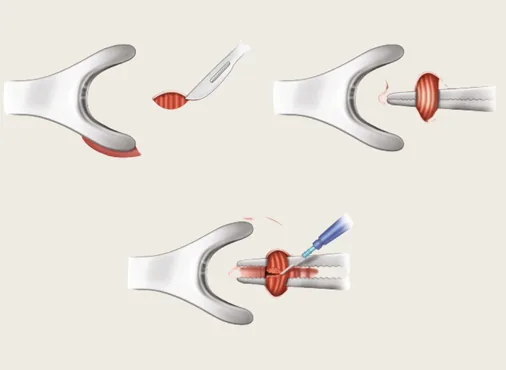
Conventional Haemorrhoidectomy (Milligan-Morgan): Surgical excision of haemorrhoidal tissue under general or spinal anaesthesia. Used for Grade IV haemorrhoids, large external components, or when other techniques are not appropriate. More post-operative pain than laser or stapler techniques but provides the most complete, definitive result for complex or large haemorrhoids.